This Blog describes reactions that a woman who was born and raised in Pawtucket has when she returns to her native city after an absence of thirty years, recalls the sites of her childhood and registers the way she is affected by the changes and lack of changes that have taken place since her childhood.
AS I got older and more educated, some of my beliefs seemed to b coming into question by the things I was learning in Science classes and Political Theory and History classes. ALSO my own experiences as I saw that I was no longer the Catholic conservative that had prayed for Joe McCarthy. I remember when Joseph Stalin died in 1953 and the nun in the 6th grade asked us all to pray for his soul. I said "I thought he was bad." AND she said "all the more reason to pray that he receives the Mercy of God. You know he once studied to be a priest--so he could not be all bad."
And those experiences began to enable me to see the mixedness of all things human. No one is perfectly good or even perfectly bad. The question is ---how is the state of our souls when we die and must face judgement.
When God manifests spirit through matter, then matter becomes a holy thing. The material world is the place where we can comfortably worship God just by walking on it, loving it, and respecting it. Everything visible, without exception, is the outpouring of God. What else could it really be? The incarnation is not only “God becoming Jesus.” It is a much broader event, which is why John’s Gospel first describes God’s presence in the general word “flesh” (John 1:14). This is the ubiquitous Christ that we continue to encounter in other human beings, in a mountain, a blade of grass, a spider web, or a starling.
When we can enjoy all these things as holy, “the world becomes a communion of subjects more than a collection of objects” as the “geologian” Fr. Thomas Berry (1914–2009) said so wisely. [1]
When we love something, we grant it soul, we see its soul, and we let its soul touch ours. We must love something deeply to know its soul (anima). Before the resonance of love, we are largely blind to the meaning, value, and power of ordinary things to “save” us and help us live in union with the source of all being. In fact, until we can appreciate and even delight in the soul of other things, even trees and animals, we probably haven’t discovered our own souls either. Soul knows soul through love, which is why it’s the great commandment (Matthew 22:36). AS I learned more and scientists learned more, I was fascinated by the BIG BANG. Then confused when it was not embraced in my Theology classes in college. So I left that college and stuck with the BIG BANG. It took me several decades of living and learning and then I came to my conclusion. The Big Bang is just another way of saying how GOD managed creation--it is not as if we need to fear SCIENCE--After all GOD is TRUTH -- SO when Science advances and finds out more about our reality, it is just showing us God's work in more detail.
There is no contradiction between true science and true God.
Saddened to hear of the death of an old friend. I met Richard in Urbana in 1967 when we were both attending the University of Illinois as graduate students. Although in different departments, we were introduced by a mutual friend and instantly clicked. Richard had a great sense of humor and also he was quite philosophical in an almost mystical way.
Our time together at Illinois was only a few years, but through the good offices of that same mutual friend, we continued to keep abreast of the developments in each other's lives. I offer my condolence to Richard's children and their mother. Richard was extremely supportive of my son Joe whom he encouraged and helped after his graduation and move to NYC.
In those years in the 80's I sometimes would also run into Richard and was always warmly welcomed to the Greenberg Associates offices in the city. Richard with his brother Robert had started a design firm RGREENBERG ASSOCIATES that soon became world famous for their extraordinary design of film titles.
I do recall several lunches in Los Angeles in the 90's when I was visiting family. Richard's creativity was enormous and wide and he had taken his talents to LA. Once over a late lunch in a place in Venice Beach we both noticed the mist beginning to envelop the scene. And I recall Richard in his poetic way saying,
"At times like this in the misty afternoon fog the dirtiness and sadness of LA seem to disappear and in the fog one can't see much but what we do see is finally beautiful,"
I have not met Richard for several years, but I am certain that as the late mists came into his life as they do to us all, anyone who looked could see his beautiful soul shining.
QUESTION? WHERE AND WHEN IS IGNORANCE BLISS? ANSWER-- RIGHT HERE IN THE BUCKET AND SURROUNDING "PLANTATIONS"
Certainly the corona virus and the upsurge of violence has combined to create an atmosphere of anxiety here. We have not gone out for several months and all appointments with doctors have been cancelled, postponed or turned into virtual visits. On the creative side I am feeling some more energy to work on a play for the Blue Cow entry into the PROVIDENCE FRINGE. SO there is a kind of busyness. But my poetry activity has stalled. Guess I have too many pots on the fire.
As usual strange things are happening in RHODE ISLAND.
The SPEAKER OF The HOUSE admitted that he didn't know there was slavery in Rhode Island's history.
Rhode Island made and sailed the majority of vessels in the slave trade . There were slaves on Aquidneck Island.
He then capped that performance by saying that he did not know what JUNETEENTH was about.
Now maybe this is an indictment of the way history is taught but it is also a naked and almost gleeful display of amazing ignorance.
I use a question to title this blog entry. WHO MAKES the MAPS? And I can follow it up with another. WHO WRITES THE HISTORY BOOKS?
The winners --that would be the answer to both questions.
Do you know this statement?
"treason never prospers because if it does none dare call it treason." By Sir John Harrington
Race riots are not new in American history--they are simply not mentioned. The neighborhoods are disappeared and the people who lived there are scattered.
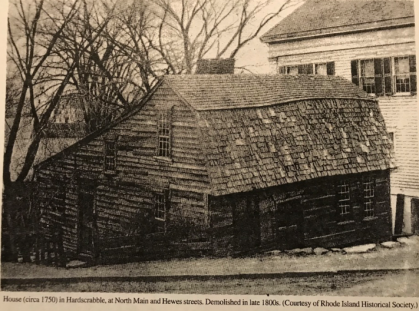
Here is David Brussat reminding us of two disappeared places in Providence, Rhode Island.
The original photograph from my 2005 column on Hardscrabble and Snowtown.
Here is my Feb. 24, 2005, column in the Providence Journal, headlined "Hardscrabble and Snowtown of yore":
***
HARDSCRABBLE and Snowtown are old Providence neighborhoods that have fallen off the map. In 1824, Hardscrabble was a poor enclave of houses owned or rented mainly by free African-Americans along Olney's Lane (now Olney Street) and North Main Street. Before blacks moved in, the sparsely populated area was known as Stampers Hill or Addison Hollow. Later, it was called Constitution Hill, and then Lippitt Hill.
Lippitt Hill, the city's oldest black neighborhood, was razed and its residents were dispersed, in 1962-68, to construct University Heights, an innovative shopping/residential complex designed by America's first major architect of malls, Victor Gruen.
By 1831, Snowtown had arisen to the west of Hardscrabble, across the Blackstone Canal (the Moshassuck River), beneath the bluff of Smith Hill, possibly right where Waterplace Park and Providence Place are today. It's hard to know for sure. Snowtown isn't labeled on old maps, or precisely located in accounts of old history. It appeared and disappeared long before the State House was completed in 1901. By then, Snowtown, not to mention Hardscrabble, had been forgotten by, I daresay, as many citizens of Providence as possible.
Why? Perhaps because they were the sites of two race riots. Their role in bringing about the town of Providence's incorporation as a city -- a step aimed chiefly to strengthen police power -- is described in the Winter 1972 issue of the Rhode Island Historical Society's quarterly, by Brown Prof. Howard Chudacoff and master's candidate Theodore Hirt.
Quoting from a report of the trial that followed the Oct. 18, 1824, Hardscrabble riot, they write: "[S]ome blacks had tried to 'maintain the inside walk in their peregrination in town,' in obvious defiance of racial taboo, and the usual 'bickerings and hostilities' ended in a sort of 'battle royal.' The following night a large number of whites, incensed by the incident, assembled on [Weybosset] Bridge and 'after some consultation' invaded the black section known as Hard-Scrabble 'which they almost laid in ruins.' " The mob of about 50, cheered on by some 100 spectators, pulled down seven houses and heavily damaged four others. Nobody tried to stop them. Only two were convicted, of minor charges.
Then it was white people destroying the Black homes and neighborhoods.
We are now living through another period of daily race riots and they are taking place in most American cities
It is as if a great violence that has been seething like an inactive volcano has finally risen to the surface and blown its top.
Maybe the months long world wide pandemic has generated the energy and now it has found an outlet.
The pandemic has exposed so many of the inequities of our society. Black people and poor people and the old, warehoused in nursing homes and rehab places, have borne the brunt of the terrible and deadly virus.
Poor people often live in crowded quarters. They do not have private bedrooms and baths . They cannot maintain social distance.
And do recall that this most prosperous country supposedly in the world still has not seen its way to providing universal health care to all its citizens. So people simply cannot afford to seek medical help.
That is the stark reality.
WE have sown the wind with injustice and racism and now we are reaping the whirlwind. MAY GOD HAVE MERCY ON OUR SOULS.
ONE OF THE NAMES IN THE JENCKES FAMILY FREELOVE When I first found this name in our genealogy and often repeated as the generations passed, I was wishing that were my name . In my mind I renamed myself Freelove Almira . FREELOVE This enables me to participate in the very nature of GOD. He is Love and He loves us. But human love can be given or with held. We can choose to love or not. One of the definitions of love is in that name--it must be free. Love cannot be coerced. That freedom is what makes our love valuable to God --we can choose not to love God. It is only we humans who have been given the free will to choose not to be what God created us to be. Surprisingly, the environmentalist and author Bill McKibben finds hope in this unique freedom. He writes:
The most
curious of all . . . lives are the human ones, because we can destroy, but also because we can decide not to destroy. The turtle does what she does, and magnificently. She can’t not do it, though, any more than the beaver can decide to take a break from building dams or the bee from making honey. But if the bird’s special gift is flight, ours is the possibility of restraint. We’re the only creature who can decide not to do something we’re capable of doing. That’s our superpower, even if we exercise it too rarely.
So, yes, we can wreck the Earth as we’ve known it, killing vast numbers of ourselves and wiping out entire swaths of other life—in fact . . . we’re doing that right now. But we can also not do that. . . .
We have the tools (nonviolence chief among them) to allow us to stand up to the powerful and the reckless, and we have the fundamental idea of human solidarity that we could take as our guide. . . .
Another name for human solidarity is love, and when I think about our world in its present form, that is what overwhelms me. The human love that works to feed the hungry and clothe the naked, the love that comes together in defense of sea turtles and sea ice and of all else around us that is good. The love that lets each of us see we’re not the most important thing on earth, and makes us okay with that. . . . [2]
THE LOVE THAT CREATED US AND NEVER STOPS FOLLOWING US AND SHOWERING US WITH HIS GRACE.
The Love that Francis Thompson saw as a Hound in relentless pursuit of our souls ---
The Hound Of Heaven
By Francis Thompson (1890)
I fled Him, down the nights and down the days;
I fled Him, down the arches of the years;
I fled Him, down the labyrinthine ways
Of my own mind; and in the mist of tears
I hid from Him, and under running laughter.
Up vistaed hopes I sped;
And shot, precipitated,
Adown Titanic glooms of chasmèd fears,
From those strong Feet that followed, followed after.
It is a kind of threat--a haunting. It strangely shifts its use of the second person from the thy, thou and thee familiar forms to the more direct and idiomatic YOU. That is the last word of the poem.
I feel the terror in this poem. The poet is finally turning to the reader and directly implicates us in the task of "earnest grasping." That is the only way we will be "conscience-calmed." The poet is saying that after his death, the way we receive or grasp his poetry will remove the pain of rejection he has known. It is our chance to repair after his death some of the damage critics and an indifferent public had done to him in life. Re-read it now and grasp the immortal one's outstretched hand. OR ELSE!
REMEMBERING OUR WOMEN POETS --Ethna Carberry and BOBBY SANDS
BOBBY SANDS WANTED TO WRITE LIKE ETHNA CARBERRY
One of the sad-funny things I learned when I read more recent accounts of Bobby Sands Hunger Strike was that he loved the poetry of Ethna Carberry. He was inspired by her poem that was a patriotic song "Roddy McCorley" and in his last days he asked his jail neighbor Brendan Hughes whom he called the Dark if he could give him a letter to mail to Ethna. He added that he did not have her address. The Dark answered "I hope you have a ouija board in there because she does not have an address. She died in 1902"
.
Here's how one reference work described the popular song:
RODDY McCORLEY. Irish, Air or March (cut time). D Major (Miller & Perron): G Major (Carlin). Standard tuning (fiddle). One part (Miller & Perron): AABB (Carlin). There were two songs named "Roddy McCorley" (spellings vary). One is older, and may have been written soon after the Irish rebellion of 1798. The other was written in 1898 for the centenary of the rebellion, and while the tune is traditional (also used for the song "Sean South of Garryowen") the words are the product of County Antrim-born Ethna Carberry . Her poetry was published by her husband after her death in The Four Winds of Eirinn (1902), and proved a popular volume that contained, among many other pieces, her "Rody M'Corley" (pp. 82-83).
The words in her version commemorate a martyr of the 1798 rebellion. They begin:
O see the fleet-foot host of men, who march with faces drawn, From farmstead and from fishers' cot, along the banks of Ban; They come with vengeance in their eyes. Too late! Too late are they, For young Roddy McCorley goes to die on the bridge of Toome today. Oh Ireland, Mother Ireland, you love them still the best The fearless brave who fighting fall upon your hapless breast, But never a one of all your dead more bravely fell in fray, Than he who marches to his fate on the bridge of Toome today.
The truth of Roddy McCorley is more complicated and confused than Carberry's portrayal. Despite some assumptions he was Catholic, the best information is that he was a County Antrim Presbyterian. He also seems to have come late to the cause of the United Irishmen, and while he may have fought in Antrim, it was for his participation in an organized patriotic gang (The Archer Gang) afterwards that seems to have been the reason for his death sentence. The song was recorded and popularized by the Clancy Brothers, the Kingston Trio and others. It is a frequently heard in march medley’s played by Irish musicians and is considered a ‘grand old chestnut’ of a tune.
Here is a verse from the lyric written by Bobby Sands:
Oh! I am Rodai of Duneane
And those of no property bear my name.
Those kingly freemen who sweat and toil
And yet who never gain nor reign.
I love these wretched gentle souls
They! condemned to death from birth,
I stand by Tone and I stand by truth
And the wretched of this earth!
From the poem Rodaí MacCorlaí written by Bobby Sands,
Bobby has transformed it into a marching song for world socialism, Wasn't he a great one!
O see the fleet-foot host of men, Who march with faces drawn, From farmstead and from fishers' cot, Along the banks of Ban; They come with vengeance in their eyes. Too late! Too late are they, For young Roddy McCorley goes to die On the bridge of Toome today.
Up the narrow street he stepped, So smiling, proud and young. About the hemp-rope on his neck, The golden ringlets clung; There's ne'er a tear in his blue eyes, Fearless and brave are they, As young Roddy McCorley goes to die On the bridge of Toome today.
When last this narrow street he trod, His shining pike in hand Behind him marched, in grim array, A earnest stalwart band. To Antrim town! To Antrim town, He led them to the fray, But young Roddy McCorley goes to die On the bridge of Toome today.
There's never a one of all your dead More bravely died in fray Than he who marches to his fate In Toomebridge town today; ray True to the last! True to the last, He treads the upwards way, And young Roddy McCorley goes to die On the bridge of Toome today.
Songwriters: J Baird / Pd Tra
YES, Bobby Sands was so taken with Ethna's work that he wrote his own ballad version of Roddy Mc Corley. He recognized a fellow patriot in the woman from Antrim.
Poets reach out to each other through time and distance with their words.
Ethna Carberry was the pen name used by a 19th century Irish poet and journalist whose short life was ended by illness at the age of 35. She collaborated on the production of two Irish Nationalist magazines with another Irish poet, her friend Alice Milligan.
Born Anna Johnston on the 3rd December 1866 in Ballymena, County Antrim. Her father was a timber merchant by trade but also a prominent Irish Republican in the Fenian movement. She was writing verse from a very young age and had her first piece published at the age of fifteen. She went on to have a number of other pieces of work published in periodicals such as the Nation, Catholic Fireside and United Ireland.
The Irish Nationalist cause was very close to her heart and she lectured up and down the country on the subject, along with Alice Milligan and Maud Gonne, the latter being the leader of a revolutionary women’s organisation called Inghinidhe na hÉireann, which translates as “Daughters of Ireland”. With Milligan’s help, she wrote plays to promote the organisation’s cultural activities. The pair were also responsible for The Northern Patriot and The Shan Van Vocht, both well-read nationalist publications. The latter title has been acknowledged as a major contributory factor to the “Irish Revival” in cultural activities.
Alice only started using the pen name Ethna Carberry in 1901 when she married fellow writer and folklorist Séamus MacManus. She explained that she did not wish to write using her now married name as she wanted to avoid being confused with him. Tragically the marriage only lasted a year as Alice fell ill with gastritis and died. Séamus lived for a further 58 years and never re-married. The impact on his life of his wife was so great, and he wrote a memoir in her honor. He published the work of Ethna Carbery in The Four Winds of Erin after her death and this collection was extremely popular.
She was, without doubt, loved throughout her native land and much further afield. The fame of Ethna Carbery spread across the Atlantic. As well as being a prominent and fervent supporter of and writer about Irish Republicanism, she wrote poetry as if her mind was:
One of her most poignant poems is reproduced here. My Dearest appears to show Ethna searching deep into her own soul for inspiration:
Ethna Carberry was a deeply patriotic individual whose love for all those who had contributed to, and died for, her country was an almost all-consuming passion and this fervour was to be found in much of her work. She wrote fluently, easily and with infectious enthusiasm. Her body of work would, no doubt have been greatly enhanced had she lived a longer life.
Ethna Carberry died on the 21st April 1902 at the tragically young age of 35.
BOBBY SANDS DIED ON MAY 6 1981 AT THE TRAGICALLY YOUNG AGE OF 27.
Two kindred spirits -- her work reached across a century and soothed the tortured body and soul of a fellow REPUBLICAN PATRIOT.