Wednesday, July 8, 2020

BLUE COW ACTING UP IN THE BUCKET


PLAYWRIGHT COMES OUT OF THE CLOSET 
--OR IS IT THE BUCKET?


Those of you who read  this BLOG know that the Blogger--ME!!--is also a poet and very interested in Poetry.

What I have not blogged much about is that I am  also a playwright. 

That interest and  play productions were more  to the fore when I was still teaching drama and playwriting at the University of Cincinnati and having my own plays produced in various Cincinnati theaters.
It was an exciting time and deserves more attention.  But when I retired completely from teaching in 2012, I was drawn back into my first passion POETRY.

In recent years  due to the good influence of a former high school student of mine who is now a college professor,  I became a founding member of the BLUE COW GROUP--a group of playwrights who formed a support group that met twice monthly to read and  improve each other's plays.
Since I left the playwriting scene  a new phenomena of ten- minute plays  has mushroomed as a way to get new work performed, and also a way to bring  beginning playwrights to the attention of theaters. It was also a way to see new writing without commiting to a full length play production.

All this history is just to  introduce my Blog Readers to an opportunity to see some of  the work of the BLUE COW GROUP which is being  staged as part of the Providence Fringe Festival.
Due to the PANDEMIC these plays will be available on ZOOM and so anyone with a computer can watch them.

So in that spirit  of trying to find the upside of these trying times, I invite each and every one of you to  follow the link below and watch the plays  wherever you are on the globe.
This is an introduction. I will provide more specifics of time and date in future blogs.

 https://www.instagram.com/p/CCWoi16nuaK/?utm_source=ig_web_button_share_sheet

Sunday, July 5, 2020

Name changing extends to Belfast Northern Ireland


Recent name changes  inspired by the  BLACK LIVES MATTER  has expanded from Columbus in the US to   leaders of colonialism in England.

 So Churchill's statue has been attacked and now we hear that the celebrated Queen's University in Belfast will be named Mairead Farrell in memory of an IRA member who was killed by British  intelligence.

Also street names have been changed  and there is now 

a BOBBY SANDS STREET!

I  hope those changes become official.


I think it is time to celebrate the 4TH of JULY with a  blow for the independence 
of the remaining  6 counties that are still held by England and considered part of the UK.

TIME TO RECALL AGAIN THE GREATNESS OF  BOBBY SANDS.

THE WRECK OF THE EDMUND FITZGERALD--BOBBY SANDS'' FAVORITE

I woke up ten mornings ago with these lyrics  repeating in my head and I thought--that wreck must have happened in NOVEMBER  and it did.

NOVEMBER 10, 1975

Wreck Of The Edmund Fitzgerald

Music and lyrics ©1976 by Gordon Lightfoot

The legend lives on from the Chippewa on down 
of the big lake they called "Gitche Gumee."
The lake, it is said, never gives up her dead
when the skies of November turn gloomy.
With a load of iron ore twenty-six thousand tons more
than the Edmund Fitzgerald weighed empty,
that good ship and true was a bone to be chewed
when the "Gales of November" came early. 

The ship was the pride of the American side
coming back from some mill in Wisconsin.
As the big freighters go, it was bigger than most
with a crew and good captain well seasoned,
concluding some terms with a couple of steel firms
when they left fully loaded for Cleveland.
And later that night when the ship's bell rang,
could it be the north wind they'd been feelin'?

The wind in the wires made a tattle-tale sound
and a wave broke over the railing.
And ev'ry man knew, as the captain did too
'twas the witch of November come stealin'.
The dawn came late and the breakfast had to wait
when the Gales of November came slashin'.
When afternoon came it was freezin' rain
in the face of a hurricane west wind.

When suppertime came the old cook came on deck
Sayin' "Fellas, it's too rough t'feed ya."
At seven P.M. a main hatchway caved in; he said,
(**2010 lyric change: At 7 p.m., it grew dark, it was then he said,)
"Fellas, it's bin good t'know ya!"
The captain wired in he had water comin' in
and the good ship and crew was in peril.
And later that night when 'is lights went outta sight
came the wreck of the Edmund Fitzgerald.

Does any one know where the love of God goes
when the waves turn the minutes to hours?
The searchers all say they'd have made Whitefish Bay
if they'd put fifteen more miles behind 'er.
They might have split up or they might have capsized;
they may have broke deep and took water.
And all that remains is the faces and the names
of the wives and the sons and the daughters.

Lake Huron rolls, Superior sings
in the rooms of her ice-water mansion.
Old Michigan steams like a young man's dreams;
the islands and bays are for sportsmen.
And farther below Lake Ontario
takes in what Lake Erie can send her,
And the iron boats go as the mariners all know
with the Gales of November remembered.

In a musty old hall in Detroit they prayed,
in the "Maritime Sailors' Cathedral."
The church bell chimed 'til it rang twenty-nine times
for each man on the Edmund Fitzgerald.
The legend lives on from the Chippewa on down
of the big lake they call "Gitche Gumee."
"Superior," they said, "never gives up her dead
when the gales of November come early!"


PROBABLY ONE OF THE GREATEST NARRATIVE SONGS WRITTEN in the 20TH CENTURY, THIS BALLAD DELIGHTED AND INSPIRED BOBBY SANDS
PLAY IT ON  YOU TUBE BY GORDON LIGHTFOOT.  It will stay in your head for days.

SO now I am reminded by the great  biography of Bobby Sands JUST AN UNFINISHED SONG  by O'Hearn which relates how Bobby loved this ballad and thought that it was the greatest song that told a story.  He sang it aloud during the prison protest and he taught it to the other men who were  imprisoned with  him.

  He confided to "The Dark", his comrade Hughes, that he wanted to write a  song about the Irish struggle to the same tune as the Edmund Fitzgerald.  He did that as O'Hearn relates that one night when they were having a sing song to keep up morale one of the other prisoners asked Bobby to sing The Wreck. 
Bobby said that he had been putting new words to it.
Then he sang THE VOYAGE a song about United Irish  prisoners who were being transported to Tasmania on a ship called The Gull.

Here are some of the lyrics that Bobby sets to the tune of The Wreck:
It was 1803 when we sailed out to sea
And away from the sweet town of Derry
For Australia bound and if we didn't drown
The mark of the  fetter we'd carry.

Here is another verse that ties together the United Irishmen and the Blanketmen:

In our own smelling slime we were lost for a time
Hoping God in his mercy would claim us
But our spirits shone high like the stars in the sky
We were rebels and no man would tame us.

Try singing these words to the tune of the Wreck and you will  see how well they fit.

Bobby was able to pass from life through suffering  to death with so much grace because he had the certainty of a martyr.
He knew that his cause, the cause of Irish Freedom,  was just and the British Imperial  claim was unjust and would be judged so by History and by God.

Tuesday, June 30, 2020

CLIMBING LADDERS TO NOTHING

Have I spent too much time climbing those ladders to Nothing?


I have just three things to teach:
 simplicity, patience,
 compassion. —Lao Tzu  
Most of us have grown up with a capitalist worldview which makes a virtue and goal out of accumulation, consumption, and collecting. It has taught us to assume, quite falsely, that more is better. 
But it’s hard for us to recognize this unsustainable and unhappy trap because it’s the only game in town. 
When parents perform multiple duties all day and into the night, it is the story line that their children surely absorb. “I produce therefore I am” and “I consume therefore I am” might be today’s answers to Descartes’ “I think therefore I am.” 
These identities are all terribly
 mistaken, but we can’t discover
 the truth until we remove the
 clutter.
The course we are on assures us of a predictable future of strained individualism, environmental destruction, severe competition as resources dwindle for a growing population, and perpetual war. 
CULTURE OF NEVER ENOUGH
Our culture ingrains in us the belief that there isn’t enough to go around, which determines most of our politics and spending. In the United States there is never enough money for adequate health care, education, the arts, or even basic infrastructure.
 At the same time, the largest
 budget is always for war, bombs, 
and military gadgets. I hope we
 can all recognize how the tragic 
consequences of these decisions 
are being played out right now.
E. F. Schumacher (1911–1977) said years ago, “Small is beautiful,” and many other wise people have come to know that less stuff invariably leaves room for more soul. In fact, possessions and soul seem to operate in inverse proportion to one another.
 Only through simplicity can we find deep contentment instead of perpetually striving and living unsatisfied. Simple living is the foundational social justice teaching of Jesus, Francis and Clare of Assisi, Dorothy Day, Pope Francis, and all hermits, mystics, prophets, and seers since time immemorial.
We must let go, to recognize that there is enough to go around and meet everyone’s need but not everyone’s greed. A worldview of enoughness will predictably emerge in us as we realize our naked being in God instead of thinking that more of anything or more frenetic doing can fill up our infinite longing and restlessness. 
Francis did not just tolerate or endure simplicity; he loved it and called it poverty. Francis dove into simplicity and found his freedom there. 
Francis knew that climbing ladders to nowhere would never make us happy nor create peace and justice on this earth. 
Too many have to stay at the
bottom of the ladder so we can 
be at the top. 

 
Epigraph: Tao Te Ching, 67. See Tao Te Ching: A New English Version, trans. Stephen Mitchell (Harper Perennial: 2006, ©1988), 67.

Sunday, June 28, 2020

SOME CONTRADICTIONS THAT HAVE HARMONIZED FOR ME

PART ONE

SCIENCE VS. RELIGION


AS I  got older and  more educated, some of my  beliefs seemed to b coming into  question by the  things I was learning in  Science classes and Political Theory and History classes.

 ALSO  my own experiences as I saw that I was no longer  the Catholic  conservative that had prayed for Joe McCarthy.  I remember when Joseph Stalin died in 1953 and the nun in the  6th grade asked us all to pray for his soul.
I said "I thought he was bad." AND she said "all the more reason to pray that he receives the Mercy of God. You know he once studied to be a priest--so he could not be all bad."

And those experiences began to enable me to see the mixedness of all things human. No one is  perfectly good or even perfectly bad.  The question is ---how is the state of our souls when we die and must face judgement.

When God manifests spirit through matter, then matter becomes a holy thing. The material world is the place where we can comfortably worship God just by walking on it, loving it, and respecting it. Everything visible, without exception, is the outpouring of God. What else could it really be? The incarnation is not only “God becoming Jesus.” It is a much broader event, which is why John’s Gospel first describes God’s presence in the general word “flesh” (John 1:14). This is the ubiquitous Christ that we continue to encounter in other human beings, in a mountain, a blade of grass, a spider web, or a starling.
When we can enjoy all these things as holy, “the world becomes a communion of subjects more than a collection of objects” as the “geologian” Fr. Thomas Berry (1914–2009) said so wisely. [1]
When we love something, we grant it soul, we see its soul, and we let its soul touch ours. We must love something deeply to know its soul (anima). Before the resonance of love, we are largely blind to the meaning, value, and power of ordinary things to “save” us and help us live in union with the source of all being. In fact, until we can appreciate and even delight in the soul of other things, even trees and animals, we probably haven’t discovered our own souls either. Soul knows soul through love, which is why it’s the great commandment (Matthew 22:36).

AS I  learned more and scientists learned more, I was fascinated by the BIG BANG.
Then confused when it was not embraced in my Theology classes in college.  So I left that college and stuck with the BIG BANG. 
It took me several decades of living and learning and then I came  to my conclusion.
The Big Bang is just another way of saying how GOD managed creation--it is not as if we need to fear SCIENCE--After all GOD is TRUTH -- SO when Science advances and finds out more about our reality, it is just showing us God's work in more detail.


There is no  contradiction between true

 science and true God.

Monday, June 22, 2020

ANNIVERSARY OF DEATH OF A GREAT FRIEND

Thinking today of one of the many sad JUNE deaths that happened two years ago.  

Here I discuss my decades long  friendship that started in grad school.

REMEMBERING RICHARD GREENBERG

Norma Jenckes
June 17, 2018

NOW ALL WE CAN SEE  IS HIS BEAUTY
Saddened to hear of the death of an old friend. I met Richard in Urbana in 1967 when we were both attending the University of Illinois as graduate students. Although in different departments, we were introduced by a mutual friend and instantly clicked. Richard had a great sense of humor and also he was quite philosophical in an almost mystical way.
 Our time together at Illinois was only a few years, but through the good offices of that same mutual friend, we continued to keep abreast of the developments in each other's lives. I offer my condolence to Richard's children and their mother. Richard was extremely supportive of my son Joe whom he encouraged and helped after his graduation and move to NYC.

 In those years in the 80's I sometimes would also run into Richard and was always warmly welcomed to the Greenberg Associates offices in the city.  Richard with his brother Robert had started a  design firm RGREENBERG ASSOCIATES that soon became world famous for their extraordinary  design of film titles.
I do recall several lunches in Los Angeles in the 90's when I was visiting family. Richard's creativity was enormous and wide and he had taken his talents to LA. Once over a late lunch in a place in Venice Beach we both noticed the mist beginning to envelop the scene. And I recall Richard in his poetic way saying,
 "At times like this in the misty afternoon fog the dirtiness and sadness of LA seem to disappear and in the fog one can't see much but what we do see is finally beautiful,"

 I have not met Richard for several years, but I am certain that as the late mists came into his life as they do to us all, anyone who looked could see his beautiful soul shining.

Sunday, June 21, 2020

UPDATE IN A DOWN TIME

QUESTION?
WHERE AND WHEN IS IGNORANCE  BLISS?
ANSWER--
RIGHT HERE IN THE BUCKET AND SURROUNDING "PLANTATIONS"


Certainly the corona virus and the upsurge of  violence has combined to create an atmosphere of anxiety here. We have not gone out for several months and all appointments with doctors have been cancelled, postponed or turned into virtual visits.

On the creative side I am feeling some more energy to work on a play  for the Blue Cow entry into the PROVIDENCE FRINGE. SO there is a kind of busyness.  But my poetry activity  has stalled.
Guess I have too many pots  on the fire.


As usual strange things are happening in RHODE ISLAND.


The SPEAKER OF The HOUSE  admitted that he didn't know there was slavery in Rhode Island's history.


 Rhode Island  made and sailed the majority of vessels in the slave trade . There were slaves on Aquidneck Island.

  He then capped that performance by saying that he did not know what  JUNETEENTH was about.


Now maybe this is  an indictment of the way history is taught but it is also a naked and almost gleeful
 display of amazing ignorance.

Saturday, June 6, 2020

WHO MAKES THE MAPS?


I use a question to  title this blog entry.
WHO MAKES the MAPS?
  And I can  follow it up with another.
WHO WRITES THE HISTORY BOOKS?

The winners --that  would be the answer to both questions.

Do you know this statement?

"treason never prospers
because if it does none dare call it treason."
By Sir John Harrington

Race riots are not new in American history--they are simply not mentioned.  The neighborhoods are  disappeared and the people who lived there are scattered. 

Here is David Brussat reminding us of two   disappeared places in Providence, Rhode Island.

Riots of Providence, 1824, 1831

by David Brussat
Screen Shot 2019-11-23 at 6.28.29 PM.png
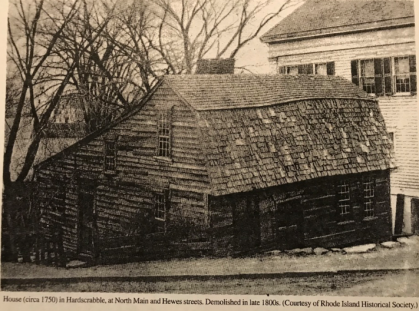
The original photograph from my 2005 column on Hardscrabble and Snowtown.
Here is my Feb. 24, 2005, column in the Providence Journal, headlined "Hardscrabble and Snowtown of yore":
***
HARDSCRABBLE and Snowtown are old Providence neighborhoods that have fallen off the map. In 1824, Hardscrabble was a poor enclave of houses owned or rented mainly by free African-Americans along Olney's Lane (now Olney Street) and North Main Street. Before blacks moved in, the sparsely populated area was known as Stampers Hill or Addison Hollow. Later, it was called Constitution Hill, and then Lippitt Hill.
Lippitt Hill, the city's oldest black neighborhood, was razed and its residents were dispersed, in 1962-68, to construct University Heights, an innovative shopping/residential complex designed by America's first major architect of malls, Victor Gruen.
By 1831, Snowtown had arisen to the west of Hardscrabble, across the Blackstone Canal (the Moshassuck River), beneath the bluff of Smith Hill, possibly right where Waterplace Park and Providence Place are today. It's hard to know for sure. Snowtown isn't labeled on old maps, or precisely located in accounts of old history. It appeared and disappeared long before the State House was completed in 1901. By then, Snowtown, not to mention Hardscrabble, had been forgotten by, I daresay, as many citizens of Providence as possible.
Why? Perhaps because they were the sites of two race riots. Their role in bringing about the town of Providence's incorporation as a city -- a step aimed chiefly to strengthen police power -- is described in the Winter 1972 issue of the Rhode Island Historical Society's quarterly, by Brown Prof. Howard Chudacoff and master's candidate Theodore Hirt.
Quoting from a report of the trial that followed the Oct. 18, 1824, Hardscrabble riot, they write: "[S]ome blacks had tried to 'maintain the inside walk in their peregrination in town,' in obvious defiance of racial taboo, and the usual 'bickerings and hostilities' ended in a sort of 'battle royal.' The following night a large number of whites, incensed by the incident, assembled on [Weybosset] Bridge and 'after some consultation' invaded the black section known as Hard-Scrabble 'which they almost laid in ruins.' " The mob of about 50, cheered on by some 100 spectators, pulled down seven houses and heavily damaged four others. Nobody tried to stop them. Only two were convicted, of minor charges.


Then  it was white people  

destroying 

the Black homes and 

neighborhoods.

We are now living through another period of

  daily race riots and they are  taking place in

  most American cities


It is as if  a great violence that has

 been seething

 like an inactive volcano has finally  

risen  to the surface and blown its

 top.

Maybe the  months long world wide pandemic

 has generated the energy and now it has found

 an outlet. 

 The pandemic has exposed so
 many of the  inequities  of our

 society.  Black people and poor

 people and the  old, warehoused in

  nursing homes and rehab  places,

 have borne the brunt of the terrible

 and deadly virus.

Poor people often live in crowded

 quarters.

 They do not have private bedrooms

 and baths
.  
They cannot maintain social 

distance.


And do recall that this most prosperous country 

 supposedly in the world still has not seen its way

 to providing universal health care to all its citizens.

So people simply cannot afford to seek medical help.


That is the stark reality.

WE have sown the wind with

 injustice and racism and now we

 are reaping the  whirlwind.


MAY GOD HAVE MERCY ON OUR 


SOULS.